About me
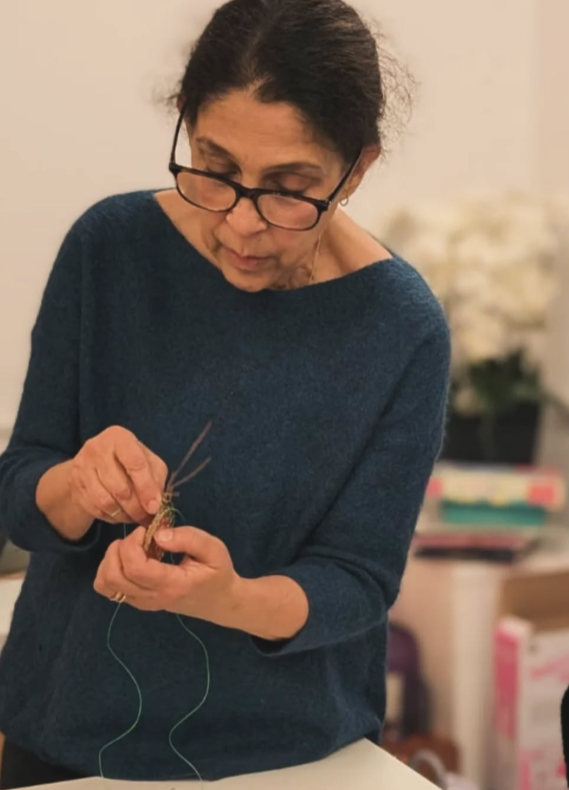
I make baskets (and more) using pine needles, a form of weaving more commonly found in North America—but I discovered it while living in Fiji. In the Pacific, weaving is everywhere, it is a living, everyday art. People create beautiful mats, baskets, and bags using pandanus leaves (voivoi) and sometimes banana leaves usually with an ‘under-and-over’ technique. How could I not be inspired? Pine needle weaving uses a different technique: coiling and stitching.
After a cyclone, I collected a fallen pine branch and noticed its long, flexible needles. I taught myself to weave by reading old library books, watching online videos, and through many trials (and many errors). It was during the pandemic, life had become strange, and making baskets was a grounding, calming way to cope.
All you need is pine needles, a needle, and a bit of thread. The coiling gesture is meditative, rhythmic, and you can soon be creative with your designs. Pine needle weaving is a sustainable craft and I have found that it encourages a closer, more attentive relationship with nature.
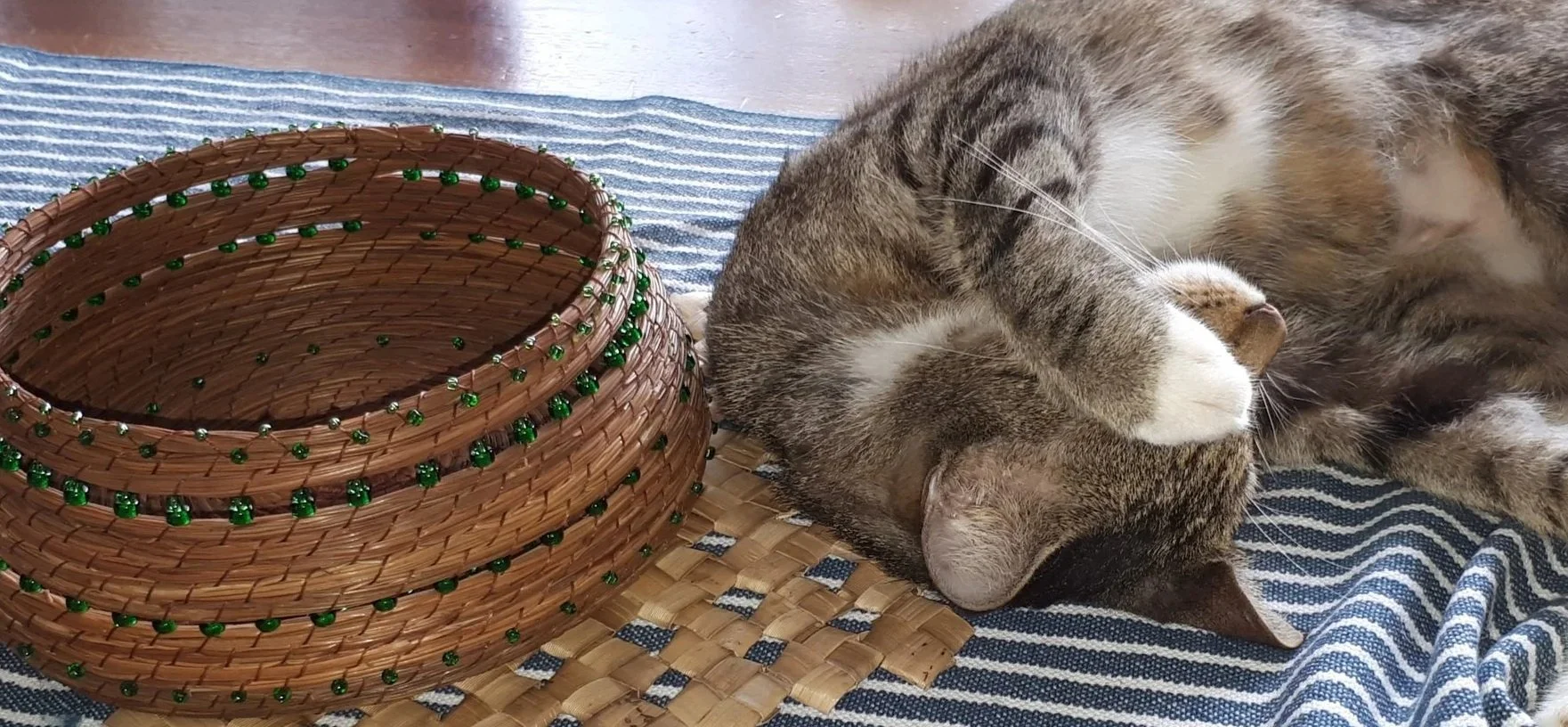
Now back in the UK, I have found pine trees with long needles so I can continue weaving. I enjoy experimenting with different stitches and playing with shape and form. Sometimes I add beads, seed pods, driftwood, or other found objects—small things gathered on my walks. I like making baskets with materials that need re-homing, pieces that reflect the time and place in which they were made. I also enjoy combining weaving with pottery; clay and pine needles seem to get along very well.
I run workshops and am happy to create special pieces on commission.
Read below about pine needle weaving, I hope to show how I appreciate the long creative traditions of those weavers who have come before me, how they inspire me.
Member of the Basketmakers’ Association.
PS Je vous écrirai tout ça en français bientôt!
About pine needle weaving
Pine trees are a familiar sight, so much so that we easily overlook them. The pine family (Pinaceae) is one of the most widely distributed conifer families, comprising about 250 species across seven genera (Encyclopaedia Brittanica). Pines are distinguished by their long needles - their leaves - arranged in bundles of two to five, and by their woody cones.
Pines have played an important role in forestry and industry for a long time. The timber is widely used for construction, furniture, and pulp and paper production. In colonial North America, pine was extensively harvested by the British Empire for shipbuilding, including the use of full-length trunks as masts. In addition to timber, pine resin has been used to produce turpentine and other derivatives. Pines have also been important sources of food and medicine in many cultures. The inner bark, seeds and cones are edible, and various parts of the tree are used in traditional medicine, for example, pine needle infusions are rich in vitamin C. The bark has been used as an expectorant and astringent, while purified pitch has been applied to wounds and infections (Mason 2024).
My own introduction to pine needle basketry took place in Fiji where pine trees are common, although they are not indigenous. Plantations of Pinus caribaea were established in the 1970s to provide building materials (Fenton and Watt 1979), these are the trees that got me started with weaving.
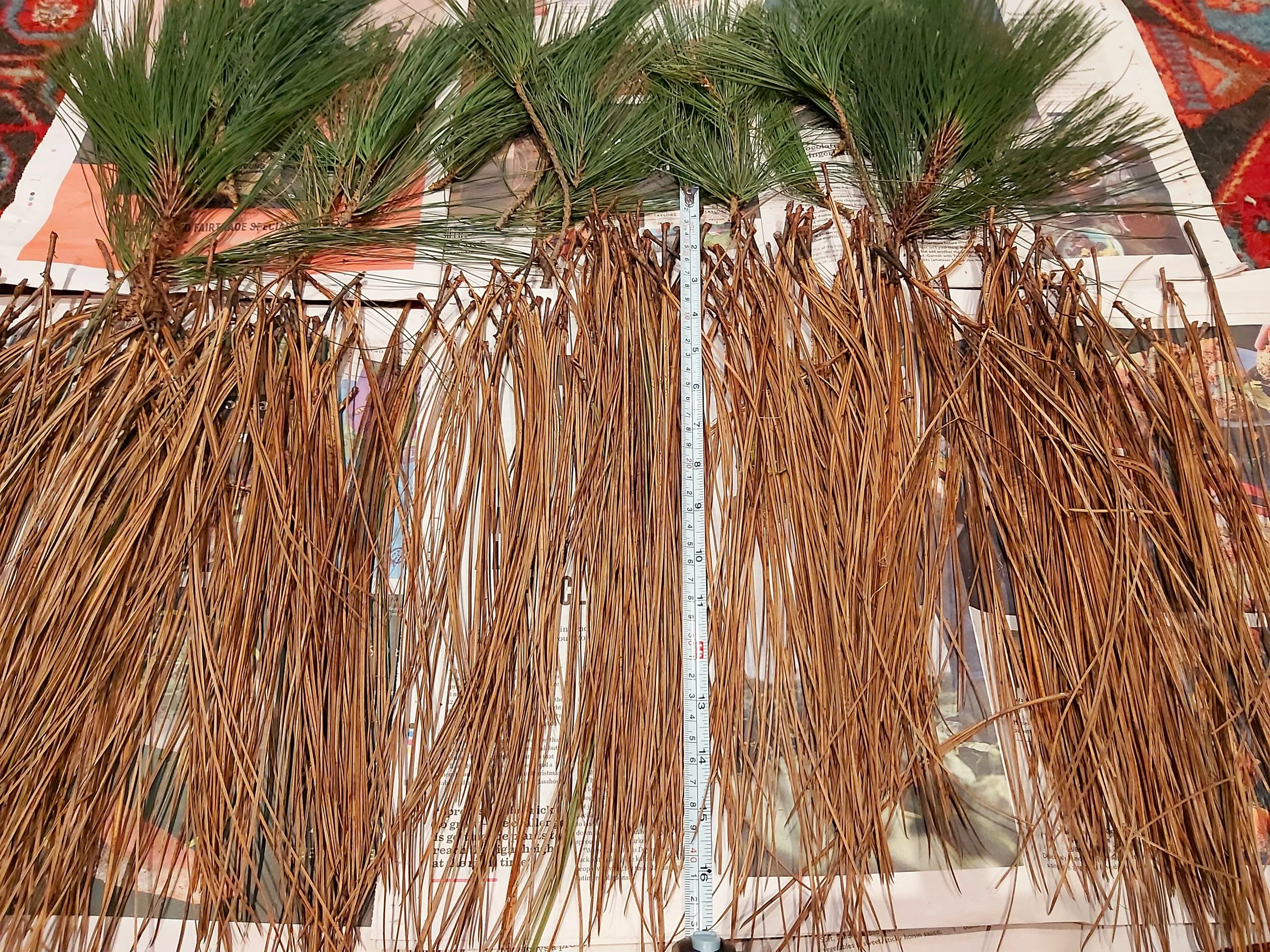
Pine needles have long been used as a material in basketry. While needles from most pine species are suitable, those with longer needles are preferred because they are easier to manipulate and produce a more consistent coil. Needles are usually harvested from the forest floor, then they are cleaned and dried.
Coiling is a technique in which a bundle of needles (the coil) is stitched in a spiral, gradually expanding outward. The repetitive nature of the process is often described as meditative, requiring sustained attention and rhythmic hand movement.
Coiled basketry traditions are found in many parts of the world, adapted to local materials and conditions. In the US, coiling with sweetgrass is indigenous, these sweetgrass baskets remain an important cultural and artistic tradition today, a shown for instance in the widely-read book Breading sweetgrass (Kimmerer, 2015). Weaving with pine needles is also indigenous, particularly where trees with long needles are abundant (Millikin, 1929). I particularly like the baskets of the Pomo people of California which are highly intricate and technically sophisticated. In Canada, pine needle basketry is more commonly associated with the west coast, where white pine and ponderosa pine are available. In contrast, it appears to be less widespread on the east coast where I come from, and in the United Kingdom, possibly due to the shorter needles of native pine species.
Pine needle basketry is a slow practice. Each row must be individually stitched onto the previous one, and even a small basket can require ten hours or more to complete. This slow, incremental process stands in contrast to mass production and highlights the value of time, skill and attention in handcraft. Through repetitive, deliberate action, simple natural materials are transformed into functional and aesthetic objects, expressing both cultural knowledge and individual creativity.
Pinaceae. In Encyclopaedia Britannica. “Pinaceae, the pine family of conifers (order Pinales), consisting of 11 genera and about 220–250 species of trees (rarely shrubs)…”. Accessed 2025
Fenton, R., & Watt, G. R. (1979). Costs of growing plantations of Caribbean pine in Fiji and radiata pine in New Zealand. The Commonwealth Forestry Review, 58(3), 191–196.
Kimmerer, R. W. (2015). Braiding sweetgrass. Milkweed Editions.
Mason, L. (2013/2024). Pine. Reaktion Books.
Millikin, L. L. (2018). Pine needle basketry: A complete book of instructions for making pine needle baskets (Reprint of the 1920 edition). CreateSpace Independent Publishing Platform.